
Total Cost of Ownership
SA equipment rental rates are brand-blind — and that changes everything
By Marcus du Toit · Published 20 Jun 2026 · Updated 21 Jun 2026 · 6 min read
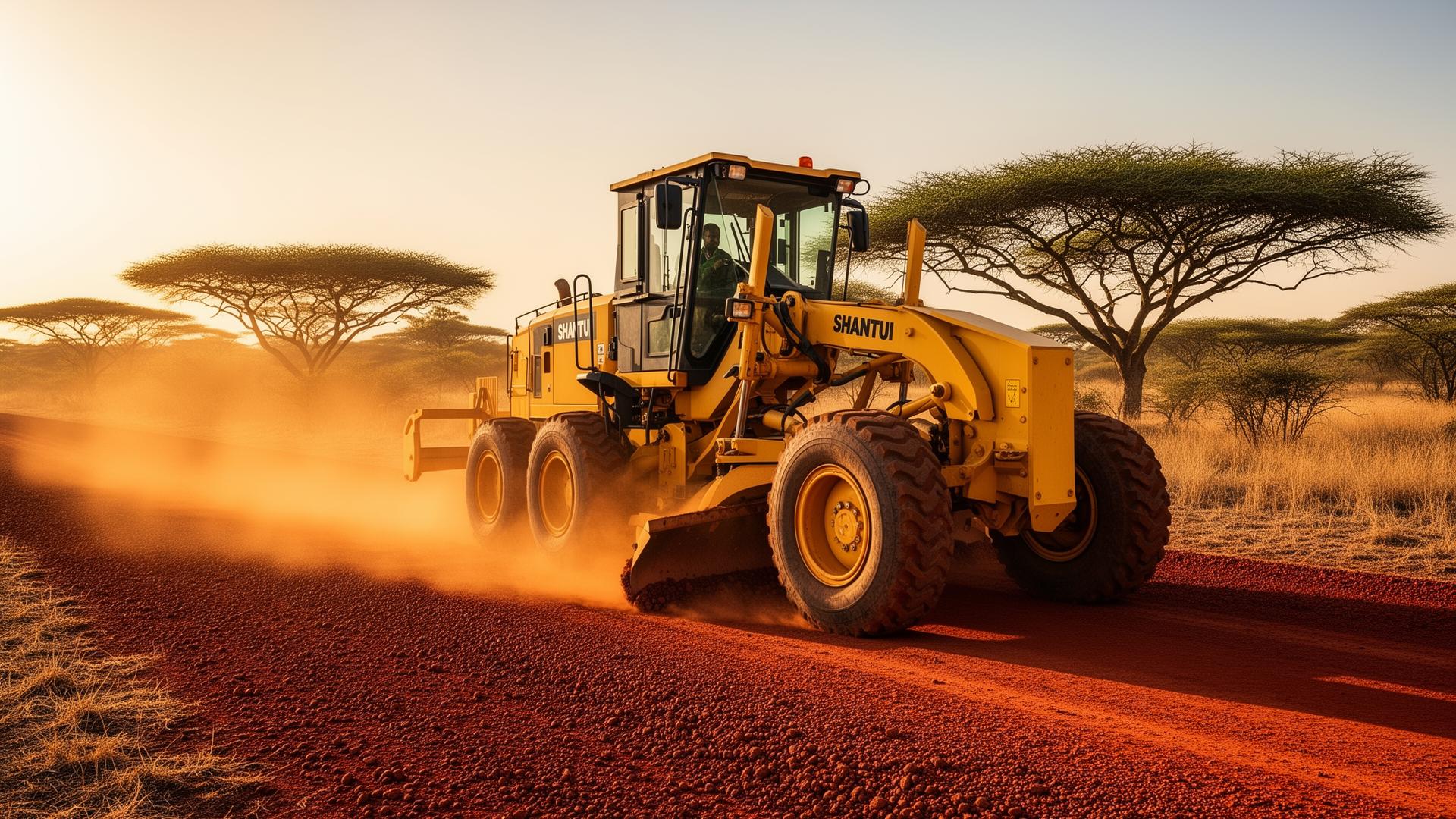
TL;DR — South African equipment rental rates are set by machine class, not brand. A 140HP Shantui SG21-3 motor grader (~R2.2m retail) and the Cat 140 equivalent (~R4.8–5.3m) earn the same hourly rental rate on open market work. Same income, roughly half the capital, similar Section 12C tax treatment — the Shantui pays back 18–30 months sooner.
"Our Shantui graders cost R2.2 million retail. A Caterpillar grader equivalent is about R4.8 to R5.3 million depending on what extras you put on. The market pays the same rental rate for both. That's the entire ROI argument in one sentence." — Marcus du Toit
The fact most plant-hire owners forget
South African equipment rental rates are set by machine class and capacity — 140HP motor grader, 20-ton excavator, 8-ton roller, 6m³ TLB — not by the badge on the bonnet. When a municipality, a civils contractor or a mining house puts out a hire request, the schedule says "supply one (1) self-propelled motor grader, minimum 140HP, with operator." It doesn't say "must be yellow with a Cat logo."
That single fact is the foundation of the rental ROI argument. The income side of the spreadsheet is identical regardless of which brand you put on site. The cost side is not.
The numbers, side by side
Real SA market pricing on a 140HP-class motor grader, June 2026:
| Line item | Shantui SG21-3 | Cat 140 (equivalent) |
|---|---|---|
| Retail purchase price | R2.2 million | R4.8 – R5.3 million |
| Typical wet hire rate (per hour) | R850 – R1,100 | R850 – R1,100 |
| Residual at 5 years (industry norm) | ~25–30% | ~50% |
| Rand value lost over 5 years | ~R1.5m – R1.7m | ~R2.4m – R2.6m |
| Tax write-off available | Full R2.2m | ~R2.5m (50% of cost) |
Indicative June 2026 figures. Resale percentages reflect SA second-hand market norms for well-maintained units with full service history. Verify rental rates against your specific region and contract type.
The resale myth, addressed properly
The standard objection to Chinese yellow equipment is "but the resale is terrible." Look at it in rand, not percentage. A Cat at 50% residual on a R5 million machine has lost R2.5 million of your capital. A Shantui at 30% residual on a R2.2 million machine has lost R1.54 million. The percentage looks worse — the actual rand loss is nearly a million less.
And during those 5 years, both machines earned the same rental income. So the Shantui delivered the same revenue while protecting more of your capital.
The tax angle most operators miss
Under SARS Section 12C wear-and-tear allowance, plant and equipment used in your business qualifies for an accelerated write-off — typically 40% in year one and 20% in each of the following three years. On a R2.2 million Shantui you can write down the full R2.2 million against taxable income. On a R5 million Cat, the same allowance writes down R5 million — but you had to find R5 million of capital to deploy in the first place.
Marcus's framing on this is sharp: "We can write off 100% of the asset's value, where a Cat can only get you to about 50% devaluation and still loses you the same amount of rand value in the asset." Same tax outcome in rand terms, less than half the capital tied up.
What it does to your fleet maths
R10 million of capital buys you two Cat graders or roughly four-and-a-half Shantui graders. Same rental rate per machine, more than double the deployed earning units, faster fleet expansion, and faster payback per individual unit. For a plant-hire business scaling against a fixed funding ceiling, this is the difference between staying at 4 machines and growing to 9.
Payback on a single Shantui grader running 1,500 billable hours a year at R950 average wet-hire lands in roughly 18–24 months. The equivalent Cat, on the same hours and rate, takes 40–55 months to recover capital. Same rental income — very different time-to-payback.
Where the Cat argument still wins
I'm not going to pretend it never does. Long-term, blue-chip contracts (Anglo, Sasol, large municipalities) sometimes specify premium brands in tender documents — usually because their own workshop and parts arrangements are built around Cat or Komatsu. If 70%+ of your future pipeline is brand-specified, the rental rate isn't actually brand-blind for you, and the maths shift.
For the other 80% of the SA plant-hire market — open-market civils, road maintenance, mining contractor work, agricultural site work — the rate is brand-blind and the ROI argument runs cleanly in Shantui's favour.
My honest take
If you're funding a rental fleet today and the income side is the same, the only honest question left is: how much capital do I really need to deploy per earning machine? The Shantui answer, in 2026 South African pricing, is roughly half. Lower purchase, similar tax treatment, smaller rand loss on resale, faster payback, more units per million of funding.
If you want me to run those numbers against your specific fleet, your finance terms and your contract mix, message me. I'll do it on a real spreadsheet, with your actual rates, not a brochure.
Want the ROI maths for your rental fleet?
Tell me the machine class, your average billable hours and your contract mix. I'll send a like-for-like Shantui vs premium-brand comparison.
Frequently asked questions
The rental ROI questions I get most often.